

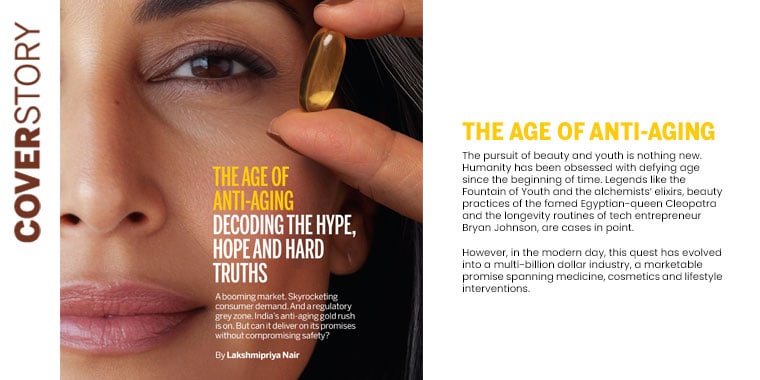
A booming market. Skyrocketing consumer demand. And a regulatory grey zone. India’s anti-aging gold rush is on. But can it deliver on its promises without compromising safety?
The pursuit of beauty and youth is nothing new. Humanity has been obsessed with defying age since the be- ginning of time. Legends like the Fountain of Youth and the alchemists’ elixirs, beauty practices of the famed Egyptian-queen Cleopatra and the longevity routines of tech entrepreneur Bryan Johnson, are cases in point. However, in the modern day, this quest has evolved into a multi-billion dollar industry, a marketable promise spanning medicine, cosmetics and lifestyle interventions.
But, the recent death of Shefali Jariwala, an Indian actress and model in her early 40s, has brought this industry under the spotlight for the wrong reasons. Reports suggest she had been regularly taking multiple anti- ageing supplements. While it’s unclear if her supplement use was linked to her cardiac arrest, the tragedy has highlighted the risks of India’s fast-growing but loosely regulated anti-ageing supplement market.
In search of gold…
And, it needs further scrutiny because we are no longer looking at a niche trend. Across urban India, even people in their 20s and 30s are turning to anti-ageing supplements. Once used by a few, these products are now main- stream, thanks to advertisements, social media, influencer outreach and upscale well- ness clinics.
Biplab Lenin, Partner, Cyril Amarchand Mangaldas, points out, “Humans have always wanted to live longer and live better. People want to look young and they have the dispos- able income to spend in order to look young.”
A report by Grandview research confirms, “The India anti-ageing supplements market generated a revenue of $214.3 million in 2023 and is expected to reach $400.7 million by 2030. The India market is expected to grow at a CAGR of 9.3 per cent from 2024 to 2030.”
So, the market opportunity is clear and unmistakable. And, startups, pharma majors and global investors are betting big on the world’s quest for eternal youth. Much like the prospectors of the 19th-century Gold Rush. Today, the ‘gold’ is the market share in a rapidly growing segment, and the new frontier is India’s fast-growing, image-conscious middle class.
But this isn’t just about vanity and beauty. A deeper shift is underway. It is about how longer healthy lifespans are reshaping how people live, work, and spend. We are seeing a spate of investments in the longevity economy, globally and in India. For instance, in June 2025, Biopeak, a health and longevity startup, raised $3 million in seed funding from Claypond Capital (Ran- jan Pai’s family office), Accel’s Prashanth Prakash, and Rainmatter. It focuses on us- ing AI and biology to improve long-term health.
Anti-ageing is a big part of this trend, and Biopeak is just one example. To under- stand the market and optimise the potential, we need to look at the bigger forces driving it.
As Dr RK Sanghavi, Chairperson, Nutraceutical Committee, Indian Drug Manu- facturers’ Association (IDMA) explains, “Medically, anti-ageing can be looked at in two ways. One is to address problems associated with the aging process, whether physi- cally or cosmetically. The second, which is more medically relevant, is to stay healthy and live longer in good health.”
He adds, “Prevention of the risk of dis- ease is going to play a more important role (in times to come) compared to the treat- ment of diseases. So, this market is not a fad, it is here to stay for the long term”.
The numbers back Dr Sanghavi’s views. A report by IMARC Group informs, “In In- dia, the broader health and wellness market reached $156 billion in 2024 and is projected to grow to $256.9 billion by 2033, expanding at a CAGR of 5.3 per cent.”
Thus, the promise of anti-ageing is powerful.

But, all that glitters….
However, often big opportunity comes with hidden peril. Like the Trojan Horse that looked like a gift but hid soldiers inside, gloss could be hiding dross, and sometimes danger.
History also offers enough parallels. In every gold rush, a few got rich while most went home empty handed. For instance, take the dot-com crash. Or the housing bubble burst. Huge promises, weak oversight and funds pouring in too fast.
Today’s anti-ageing boom carries the same warning signs, a similar pattern. Ex- perts caution that unless backed by ade- quate regulation, scientific validation and consumer education, breakthrough will become backlash.
“The Indian masses are increasingly jumping onto the ‘anti-ageing bandwagon’ and the manner in which such anti-ageing supplements or procedures are being delivered seems to work in a regulatory grey zone. Procedures which should be done only by doctors are being undertaken at shady spas and salons, the nuisance of self-medication when it comes to health-supplements is also increasing. The masses are usually ill-informed as any anything cos- metic-related is not considered by the lay man as medical in nature, therefore, people are willing to take glow drips wherever these are available at a cheap rate, and are popping pills left, right, and centre,” highlights Lenin.
“With the regulations not being very stringent, some market players might even want to take benefit of the first-mover ad- vantage as long as the regulatory grey area persists. With all these parameters, anti-ag- ing and longevity are definitely compelling investment opportunities for the market.”
Mumbai-based plastic surgeon Dr Devayani Barve reiterates this view and cautions that “high doses of vitamin E or NAD can impair cardiac function, and IV drips with magnesium, potassium, or calcium can trigger dangerous heart rhythm disturbances. These are promoted as ‘quick fixes’ which cause no harm. This belief is dangerous.”
From an investor’s lens, these issues are not just red flags that could impair public health, but a Pandora’s Box that could cause serious harm to reputation and invite severe backlash.
And, these risks bring us to the crux of the whole matter: regulation.
The shades of grey: Inside India’s regulatory maze
Regulations will be the key to turning this fast-moving market into a sustainable, cred- ible industry. A clear, streamlined frame- work, will be the decisive factor between boom and bust, opportunity and crisis. But, the current regulatory scenario is a maze of overlapping rules and agencies.
Rishi Agarwal, CEO and Co-founder of Teamlease Regtech, gives a detailed overview of the existing regulations, “India regulates nutraceuticals and dietary supplements under the Food Safety and Standards Act, 2006, with specific rules framed by the Food Safety and Standards Authority of In- dia (FSSAI).”
He informs that the key regulations applicable to this space include:
- Food Safety and Standards (Health Supplements, Nutraceuticals, Food for Special Dietary Use, Food for Special Medical Purpose, Functional Foods and Novel Foods) Regulations, 2016 (known as Nutraceutical Regulations)
- Labelling and health claims are governed by two separate regulations:
- Labelling and Display Regulations, 2020
- Advertising and Claims Regulations, 2018
Agarwal explains that every manufac- turer must obtain a valid FSSAI license to market nutra products. If the product uses only pre-approved ingredients in permissible quantities, it does not need separate prod- uct approval. However, for novel ingredients or higher-than-permitted dosages, FSSAI conducts scientific risk assessments before granting product-specific approval.
He adds that FSSAI mandates nutrient content not exceed the Recommended Dietary Allowance (RDA) set by the Indian Council of Medical Research (ICMR). Where Indian RDAs are unavailable, Codex Alimentarius or internationally accepted references are consulted, though final approval still rests with FSSAI.
Labels must transparently declare ingredients, usage instructions, and warnings (such as ‘NOT FOR MEDICINAL USE’) and clearly identify the intended consumer group. Therapeutic, disease-curing, or drug- like claims are prohibited. Only structure- function and general wellness claims sup- ported by scientific evidence are allowed. In June 2025, FSSAI explicitly banned ‘100 per cent’ claims (for instance, 100 per cent cure, 100 per cent safe) to address rampant con- sumer misinformation.
The ingredients used must also conform to purity standards specified in official gazettes, the Indian Pharmacopoeia (IP), or globally accepted compendia. If not specified, manufacturers must declare the criteria adopted.
Agarwal cautions, “While India’s regula- tory framework is relatively robust on paper, implementation gaps persist, particularly in monitoring advertising practices and post-market surveillance. Recognising this, an inter-ministerial committee in 2024 pro- posed shifting the regulation of certain high- risk categories—such as vitamins, minerals, and amino acids in therapeutic dosage forms—to the Central Drugs Standard Con- trol Organisation (CDSCO). Under the proposal, FSSAI would continue to oversee food- grade applications, while CDSCO would regulate products bordering on therapeutics, especially those making disease risk-reduc- tion (DRR) claims.”
Other experts also underscore the fragmented nature of the current framework and advocate for streamlining it.
Lenin states, “With the longevity and bio- hacking industry gaining traction, having a separate regulatory framework for the same might help, especially for streamlining the regulatory regime which is at present quite fragmented and spread across various legislations and departments like the CDSCO, FSSAI, AYUSH, etc. While these regulations independently do provide for detailed frame- works of scrutiny, the challenge is that with a melange of regulations, it becomes easy to es- cape from the loose ends. Therefore, a clear framework for the manner of scientific substantiation, marketing, tiered risk-based scrutiny across supplements and IV drips, etc., training of professionals undertaking beauty procedures, availability of products over the counter, etc., would be ideal.”
Dr Sanghvi highlights critical gaps, “Nutraceuticals are not included in the medical curriculum. FSSAI also has significant gaps in understanding nutraceuticals, which makes it very difficult to provide proper guidance. Regulations should be aligned with global standards. For example, Codex Alimentarius is a global regulatory framework. India is a member, but we have not fully synchronised our regulations with Codex.”
 Cutting through the Gordian Knot
Greek legends mentions the Gordian knot. It was so complex that no one could untie it. Alexander the Great cut through the knot with a single stroke of his sword. Nutra regulations are similar. Complex, overlap- ping, and difficult to untangle. The only way forward is to cut through the mess with clarity, vision and smart reforms.
Industry experts also recommend that balanced regulation is the need of the hour. The challenge is to create a framework that adapts to different levels of risk and innovation.
Lenin opines, “While it would not be prudent to regulate the same as strictly as drugs, it is also not ideal to keep the regula- tory framework lingering with loose ends,” he adds.
“It is important to understand that if such a regulation does come into effect, it should not stifle innovation and should cater to the various categories of longevity and bio-hack- ing industry – for instance, while moderate oversight would work for supplements and nutraceuticals, strict protocols should be provided for beauty-medical procedures. One formula for all would not be ideal,” he advises further.
Agrawal stresses on the importance of smarter compliance frameworks, and says, “India does not need more regulations; it needs better ones. The first step is regulatory clarity. Distinguishing between general health supplements (under FSSAI) and therapeutic or high-risk products (under CDSCO) is essential to apply the right degree of scrutiny. Without this segmentation, innovators are left navigating ambiguity that delays both development and access.”
He adds, “What we need is an intelligent overhaul of the existing regulatory frame- works, streamlined, risk-based and responsive to innovation. The current laws should be amended to reflect emerging market realities. Reforms must be grounded in global best practices- adopted thoughtfully, keeping India’s developmental context in mind. Many developed nations are actively rethinking how to regulate the intersection of health, tech and wellness. India must do the same but through recalibration and not redundancy.”
According to him, a risk-based classification system for ingredients is key. “Products made with safe, well-established, or natu- rally occurring ingredients should undergo faster approval cycles, while those involving novel, high-risk, or allergy-prone components should face stricter evaluation and longer approval timelines. Ingredients known to have potentially lethal side effects or aggravate serious medical conditions should face prohibition or enhanced regula- tory screening.”
He outlines, “Most importantly, the compliance burden must be natively digital. Approvals, registrations and filings should be intuitive, tech-enabled and built for scale. Compliance should not be a bottleneck to progress, it should be a seamless part of doing business.”
Dr Sanghvi stresses the need for stronger industry self-regulation, “Voluntary quality marks, third-party validations, and honest consumer education should become the norm. If we don’t self-regulate, we will face over-regulation.”
At the crossroads
Despite the risks, we are witnessing a lot of funds pouring in. Why? Because the potential is immense. And, this race isn’t limited to supplements alone. India’s nutraceuticals market, that includes functional foods and herbal extracts too, reached “$8.78 billion in 2024 and is expected to reach $23.51 billion by 2032, growing at a CAGR of 13.10 per cent from 2025 to 2032,” according to ASD Reports.
This growth is driven not just by consumer demand but also by demographics. India had an elderly population of 153 million (aged 60+) in 2023, set to more than double by 2050, according to the United Nations Population Fund (UNFPA). Rising rates of diabetes and cardiovascular risks also propel the demand for preventive healthcare.
Thus, for India, the opportunity is twofold: a large domestic market and global export potential. Companies or brands that achieve a breakthrough first will get to de- fine how the segment works and is perceived. Dr Sanghvi highlights, “Exports of nutraceuticals from India are encouraging because we offer quality products. We also have a cost advantage, which is a key driver for export growth in the global market.”
These perspectives from experts and analysts highlight that the India’s anti-ageing industry is at crossroads. Will it continue as a high-growth but high-risk sector, or evolve into a trusted, competitive choice for longevity science? The answer lies in how businesses, regulators and stakeholders choose to act today.
A promise and a puzzle
India’s anti-ageing boom is at an inflection point. It marked by big bets and disruptive promise. The players who treat this as a long game, invest in research, prioritise quality, build science-backed products, ensure regula- tory compliance and win consumer trust, will be the ones who endure. In the end, those who invest boldly, but with discipline, credibility and foresight will emerge winners in this race.
