

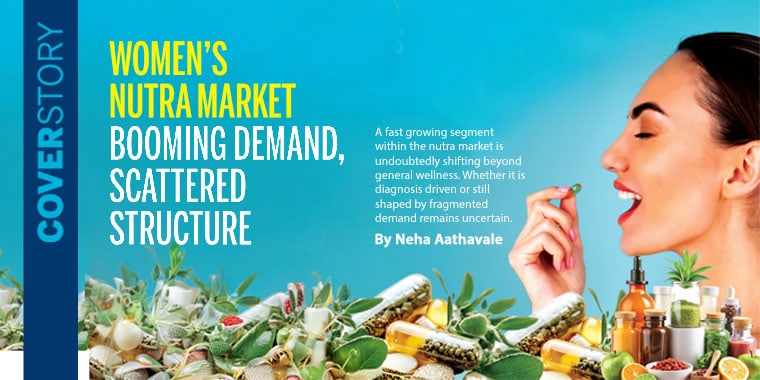
India is undoubtedly witnessing a loud boom in nutraceutical supplements, almost like a tree branching out in different directions. Within this, women’s health nutraceuticals in India are also expanding at pace, steadily carving out their own space within the broader market. However, whether this growth is gradually being pruned into a defined structure or continuing to branch out unpredictably remains unclear.
This expansion is not occurring in isolation. It sits within a broader shift underway in India’s wellness economy. The Indian women’s wellness nutraceutical segment is in the middle of a clear transition in 2026, moving from generic nutrition products toward more targeted, science-backed solutions.
This shift is being shaped by a high prevalence of hormonal imbalances, rising health awareness, and a growing preference for preventive routines over curative care.
This evolution is also reflected in the size and segmentation of the market. The Indian women’s health and beauty supplements market stood at $4.41 billion in 2024 and is projected to reach $6.98 billion by 2030, driven by increasing attention to hormonal health, preventive care, and life-stage specific needs. On the surface, this points to a category that is steadily maturing and beginning to find clearer contours.
Yet, beneath this visible expansion, the underlying structure of demand remains less defined. The key question, therefore, is not just how fast the category is expanding, but what is shaping this expansion. Is women’s health emerging as a diagnosis-influenced nutraceutical market sector, or is it still a commercially fragmented space shaped by clinical guidance, self-medication, and digital influence?

From wellness to why
To understand this, the first layer to unpack is what is actually driving the growth of women’s health nutraceuticals in the first place, and how consumer intent itself is being reshaped. What is powering this growth is not a single driver, but a layering of health concerns, lifestyle shifts, and changing expectations from nutrition itself. Women’s health nutraceuticals are increasingly moving into a space where nutrition is no longer seen as general maintenance, but as a response system for specific conditions, life stages, and physiological stress signals.
Sagar Pawar, Partner at KPMG India, points out that this expansion is also being reinforced by a dual structural reality: rising awareness on one side, and persistent nutritional gaps on the other. “The growth in women’s health supplements is being driven both by the rising health awareness and underlying nutritional deficiencies,” he explains, adding that increased self-education and disposable incomes are enabling women to actively seek solutions for previously under-addressed conditions such as PCOS and menopause, while lifestyle-related deficiencies continue to remain widespread.
Adding onto it, Gurmeet Kaur, CoFounder and Director of Ubalance Naturals, highlights, this change is first visible in how women are reframing health itself. “Women are no longer just asking how to look better or lose weight,” she notes, adding that the focus has shifted towards “longevity and quality of life and not wanting to compromise on either.” What is changing, she says, is not only intent but also the depth of questioning. “Why do I feel exhausted even after eight hours of sleep? Why is my energy dipping? Why are my moods all over the place?” These questions, she points out, reflect a clear movement away from aesthetic health towards functional understanding, where the body is being seen less as an appearance system and more as a performance system.
This shift is also reshaping how health is being interpreted inside nutrition frameworks. Instead of isolated symptoms, there is now greater emphasis on interconnected biological pathways, where gut health, liver function, stress response, and nutrient absorption are viewed as part of one continuous system. Within this framing, hormonal imbalance is increasingly understood not as a standalone condition but as a downstream outcome of multiple internal disruptions, reinforcing a move from surface-level correction to system-level support.
At the same time, extending what Pawar noted earlier about the widening of intent and self-awareness among women, the shift is also visible in how women are entering the category. As Pranshul Aggarwal, Founder of LivLively, explains, the growth in demand is being shaped by overlapping lifestyle and health realities rather than a single trigger. He adds that this where many women now begin supplementation as part of everyday self-care, without necessarily waiting for a formal diagnosis. This reflects a broader shift where awareness itself is becoming an entry point, not just medical necessity.
At a broader demand level, this behavioural shift is reinforced by life-stage awareness and preventive health thinking. Mintel data indicates that consumers aged 25–34 are increasingly focused on preventing early health issues, while older cohorts are more focused on delaying ageing and maintaining long-term health. This layering of intent across age groups is quietly becoming one of the strongest forces shaping how women’s health products are being positioned, consumed, and repeated over time.
Many doors, no single path
While these shifts explain what is driving growth, they do not fully explain how women are actually entering the category, or why the same health concerns are taking such different routes into the system.
At the consumer level, this entry is far from uniform. As Aggarwal explains, the pathway into women’s health supplements depends on both awareness and the nature of the concern itself. “This has created multiple entry points into the category,” he notes, adding that “many consumers now begin supplements as part of daily self-care, for issues like fatigue or iron deficiency, without waiting for a formal diagnosis.” At the same time, he points out that for more complex conditions, there is still a clear reliance on medical guidance. “For specific or complex conditions, there is a tendency to consult a doctor or undergo diagnostic tests before opting for targeted supplementation,” he says, highlighting the coexistence of self-led and clinically guided entry routes.
This dual pathway becomes even more visible within clinical practice. Samant explains, there is still a clear divide in how supplements are being used. “While some individuals may receive recommendations based on clinical necessity and biochemical assessments, an enormous amount of other individuals self-medicate using dietary supplements,” she notes. According to her, this behaviour is often influenced by “peer reviews, social networks, or aggressive marketing directed straight at consumers.”
This inconsistency at entry naturally extends into how supplements are used. Malladi, points out that the issue is not just access, but application. “Supplements are among the most misused tools in hormonal health,” she notes, adding that problems around incorrect form, dosage, and combination are common, with many consumers choosing what is available rather than what is clinically appropriate.
At a structural level, this lack of uniformity is not incidental but deeply rooted. Pawar observes, women’s health has historically been managed through symptom-based, fragmented care pathways, where supplementation sits between clinical advice and consumer behaviour rather than within a unified system.
These gaps become even more pronounced when it comes to adherence. Even when supplements are clinically recommended, long-term consistency remains a challenge. “Most people discontinue their consumption upon improvement in symptoms or absence thereof, due to expense, difficulty of daily consumption, and lack of guidelines on duration of therapy,” Samant explains, pointing out that conditions like PCOS, anemia, and hormonal imbalance require sustained intervention, which is often missing in real-world behaviour.
Malladi reinforces this from a behavioural lens. “Most clients stop within four to six weeks, assume the product didn’t work, and move on to the next recommendation,” she says, noting that hormonal interventions typically require at least three months to show measurable change. She also flags over-supplementation as a growing concern, where individuals stack multiple products without understanding interactions or absorption conflicts, often weakening overall efficacy.
Taken together, these patterns reveal a category that is expanding faster than it is aligning. Across both clinical and consumer ecosystems, supplementation is increasingly being adopted, but not always within a structured framework of diagnosis, duration, or compliance. The result is a space shaped simultaneously by medical advice, self-directed experimentation, and digital influence, often without clear alignment between the three.

Scaling without structure?
As the branches multiply and grow in different directions, the question shifts to the shape of the tree itself. Is the industry moving towards coherence, or simply scaling within fragmentation?
At a structural level, the category has historically leaned towards the latter. As Pawar observes, the women’s health supplements market has long operated in a fragmented form, especially outside basic vitamins and minerals. “Historically, the women’s health supplements market has been largely fragmented,” he notes, pointing out that much of its evolution has been driven by scattered product development rather than a unified system of care. However, he adds that this is beginning to change. “The recent entry of large pharma and women’s health players indicate a gradual shift toward a more structured and organised market in near future.”
This shift is most visible in the emergence of condition-led segments. Categories such as PCOS, fertility, menopause, and anemia are increasingly being positioned within broader clinical pathways, rather than as standalone wellness solutions. Yet even here, alignment remains partial, as clinical practice, consumer behaviour, and product development continue to evolve at different speeds.
Beneath this visible movement towards structure, however, deeper operational challenges persist. As Gaurav Soni, Founder and Managing Director of Botanic Healthcare, explains, consistency in nutraceuticals is still heavily constrained at the manufacturing level. “The chemical profile of a plant can vary significantly depending on geography, soil conditions, and harvest timing,” he notes, adding that without tight control over sourcing, maintaining batch-to-batch consistency becomes difficult.
He points to examples such as KSM-66 Ashwagandha, where region-specific sourcing from Rajasthan enables standardisation through strict raw material selection, underscoring how precision begins at the source itself.
Standardisation, however, extends beyond sourcing into infrastructure. Soni highlights that defining measurable quality benchmarks and building the testing systems to validate them remains a challenge in India, particularly due to cost and accessibility constraints. “While India has strong expertise in chemistry, challenges persist in translating that into consistent manufacturing quality, standardisation, and testing,” he explains, emphasising that the gap lies less in scientific capability and more in execution discipline across the value chain.
Even as the industry attempts to address these gaps, formulation philosophy itself is evolving. As Soni notes, the shift is moving away from ingredient-heavy complexity towards precision. “Earlier, complexity was equated with efficacy, with formulations often combining dozens of ingredients in high doses. That approach is steadily being replaced,” he says, adding that the focus is now on “bio-intelligent molecules and targeted intervention rather than overloading the system.”
Yet, translating this precision into realworld outcomes remains uneven. As Malladi points out, “there’s often a visible distance between the protocol a client needs and the one they can realistically follow,” highlighting constraints such as limited access to diagnostics, entrenched dietary habits, and the realities of shared household consumption.
She further notes that even when structured protocols exist, perception continues to shape behaviour. “Even among well-informed clients, supplementation is often seen as a short-term fix rather than a long-term physiological process,” she says, pointing to a persistent mismatch between clinical timelines and consumer expectations.
Taken together, these layers suggest a category that is evolving, but not yet fully aligned. While shifts towards clinical integration and precision are visible, the system continues to operate across loosely connected layers where demand, diagnosis, and usage do not always converge. What emerges is a market still in the process of finding its shape.
Conclusion
At the end, what emerges, then, is not a market that lacks direction, but one that is still negotiating it. Women’s health nutraceuticals in India are no longer a loose collection of wellness products, yet they are not fully a clinically anchored system either. They sit on a fence, where diagnosis, self-care, and digital influence intersect, but do not always align. The real shift will not be defined by how many products enter the market, but by whether these layers begin to connect. Until then, the category may continue to grow, but its structure will remain a work in progress, still being shaped even as it scales.
[email protected]
[email protected]
