

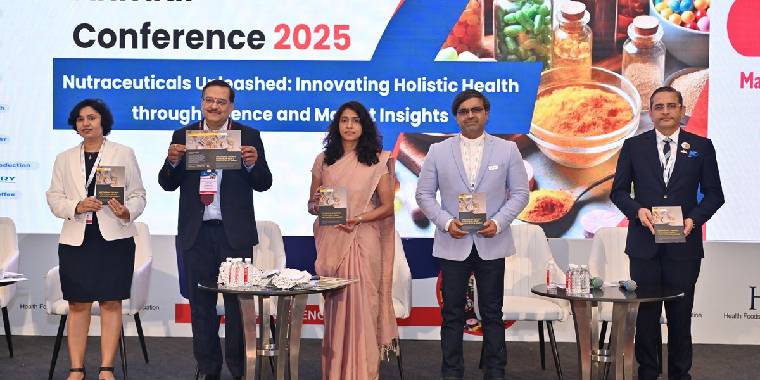
Industry leaders and regulators discuss market strategies, evolving FSSAI guidelines, and global trends at HADSA’s flagship event in Mumbai
The Health Foods and Dietary Supplements Association (HADSA) recently hosted its Annual Conference 2025 in Mumbai, themed Nutraceuticals Unleashed: Innovating Holistic Health through Science and Market Insights. The conference was chaired by Hitesh Patel, managing committee member of HADSA and managing director of K Patel Phyto Extracts.
Setting the tone for the event, Guest of Honour Pritee Chaudhary, Regional Director (West), FSSAI, addressed the industry’s regulatory challenges, emphasising the need for affordability and accessibility. She stated that nutraceuticals must be competitively priced, ideally lower than pharmaceutical products, to drive wider adoption. Highlighting the government’s focus on integrating modern science into nutrition to improve public health, she stressed that while medicines are used for treatment, nutrition is a continuous requirement. Acknowledging challenges in regulatory approvals, she called for streamlined application processes to facilitate faster clearances without compromising governance. She reassured stakeholders that FSSAI prioritises governance over bureaucracy and aims to balance business needs with consumer protection. Urging companies to ensure scientific validation and transparency in product claims, she underscored the importance of collaboration between industry and regulators to create a compliance-driven ecosystem.
The role of regulation in fostering industry growth was further explored in the CEO panel, which examined strategies for scaling the nutraceutical sector, particularly as pharmaceutical companies increasingly enter the space. Moderated by Ajit Singh, Chairman of ACG and HADSA, the discussion featured Pradeep Gadre of Scitech Specialities, Prashant Nagre of Fermenta Biotech, and Deepak Goyal of Tirupati Group. The panelists identified innovation as the primary driver of growth, highlighting the role of continuous product evolution, consumer education, and emotional storytelling in marketing. They discussed how pharmaceutical players are bringing clinical expertise, traceability, and regulatory compliance to the industry, thereby strengthening standards. Affordability and accessibility remained a focal point, as panelists noted that while premium consumers associate price with quality, middle-class and lower-income groups require cost-effective and awareness-driven solutions. With India’s aging population, ensuring broader access to nutraceuticals is becoming increasingly critical. The panel also emphasised the need for regulatory clarity as India considers merging its nutraceutical and pharmaceutical regulatory frameworks. Participants urged the government to streamline policies and establish quality benchmarks beyond GMP compliance, including production and equipment standards. They further discussed the importance of global technology adoption to improve product quality and industry credibility. Aligning with advanced scientific standards, they argued, could strengthen India’s positioning as a global leader in nutraceuticals.
As the discussions delved deeper into the regulatory landscape, the second panel focused on the evolving FSSAI guidelines and the need for structured compliance mechanisms to ensure product safety and consumer trust. Moderated by Dr. Vaibhav Kulkarni of Zantus Life Sciences and HADSA, the discussion included Nirupama Sharma of Amway India, Vaidehi Kalzunkar of FSSAI, Yogish BT of Herbalife, and Ashwin Bhadri of Equinoxlabs. The panelists stressed the need to balance stringent regulatory compliance with fostering innovation, particularly in ingredient selection for targeted consumer needs. Industry collaboration was identified as essential for setting clear regulatory standards, with suggestions for training initiatives at various levels to enhance consumer awareness. The discussion also underscored the importance of third-party testing in verifying product purity, with unbiased validation playing a key role in building consumer confidence. The panelists highlighted the growing importance of scientific validation for product claims, asserting that every claim must be backed by detailed research to avoid regulatory scrutiny. They noted that international regulatory bodies require extensive documentation of ingredient concentrations and extraction ratios before approving claims, a practice that is becoming increasingly relevant in India as well.
Beyond regulatory discussions, the conference also provided insights into market trends and business strategies shaping the future of nutraceuticals. Individual sessions examined key trends, strategies for scaling startups, and the evolving nutraceutical landscape. With India’s nutraceutical market currently valued at $58 billion and growing at a CAGR of 11 per cent, the discussions highlighted a surge in demand for products targeting sexual wellness, gut health, and stress relief. The shift towards plant-based and clean-label supplements is shaping consumer preferences, though navigating FSSAI and Ayush Ministry regulations remains a challenge. With 70 per cent of Indians facing nutritional deficiencies and over 100 million diabetics, demand for sugar-free and functional foods is increasing. Mental wellness supplements, including ashwagandha and L-theanine, and anti-aging ingredients such as NAC, curcumin, and CoQ10, are gaining traction in the market. Achieving product-market fit was another key theme, with panelists discussing the role of packaging, scientific validation, and convenient formats in differentiating products. While premium brands continue to target high-income consumers, mass-market players are focusing on affordability through innovative business models such as subscription-based health kits and personalised nutrition solutions.
With innovation and regulation emerging as the two key pillars of growth, India’s nutraceutical industry is poised for significant expansion. The market is expected to reach $18 billion by 2025, driven by rising investment and health awareness. Globally, the nutraceutical sector is projected to hit $599 billion by 2030, with North America leading the space. Personalised nutrition is emerging as a key trend, expected to reach $23.3 billion by 2027, as advances in genomics enable customised dietary solutions.
As India aims to establish itself as a global leader in nutraceuticals, the HADSA Annual Conference 2025 underscored that sustainable growth will depend on a combination of scientific innovation, regulatory compliance, and consumer trust. Collaboration between stakeholders and regulators will be essential in shaping a transparent, high-quality, and consumer-focused nutraceutical ecosystem.
